
Why Small Change Makes a Big Difference
The $10 Kindness Club: Making Change with a Few Dollars
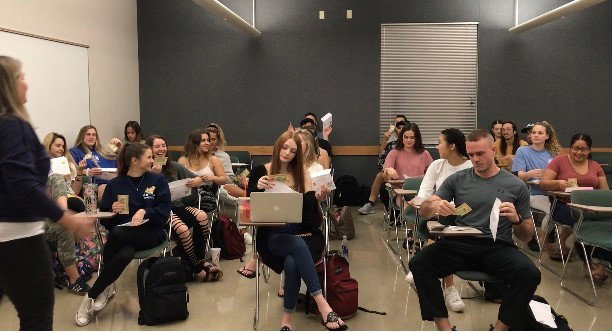
I taught the first kindness class at Florida Gulf Coast University in Fort Myers, Fla. The class brought students who wanted to understand kindness and how it could change them and the world at the same time – it was called The Kindness Effect.
It was a novel approach to learning. Kindness can be taught. Science and research continue to demonstrate that kindness is a critical to our success as human beings. And right now, the United States is suffering a kindness deficit. The students who enrolled in my kindness class don’t arrive with hardened hearts looking to be kinder. Many want to strengthen their kindness muscles and make a difference.
Some of these students had not seen much kindness and wanted to see it first-hand. Some had been manipulated by kindness. Some had been blessed with kindness and wanted to pay it forward. Some understood kindness but weren't very kind to themselves. They all wanted to live in a kinder world.
Besides studying the science and research around kindness, they also completed a variety of kindness challenges, which often pushed them out of their comfort zone. One of those assignments was the $10 Kindness Challenge.
In the past, I felt like philanthropy belonged to the rich. And that type of thinking prevented me from giving what I could with what I had. But philanthropy comes in all degrees and I wanted to empower my students to make a difference in the ways that they could. So, I thought I would see what kind of magic we could create with $10.
I asked a friend, Sharon Arnold, if she would become our “kindness patron.” If artists can have patrons, why can’t kindness students? For six semesters, Sharon gave $10 to each student in my class. They had two weeks to spend it on someone in need. They could spend it in any way they wished as long as it involved an interaction.
There were some rules. They couldn't donate anonymously. First, I advised them to carry it with them and see if something occurred naturally the first week. If not, they needed a Plan B to spend the money the next week. They also had to present how they spent the money to the class and write a paper about it, which included three research elements that illustrated why giving is important.
Some wonder if the money would be more impactful if it came from the student’s own pocket. But research says no. And after watching more than 300 students participate in the $10 Kindness Challenge, I can attest that it doesn’t matter where the money came from. The results and experiences have been so powerful that the giving is both beneficial to the giver and the recipient.
I have never looked at $10 the same since I started this challenge. Some of the experiences my students have had giving away $10 may convince you to participate in the $10 Kindness Challenge – I hope so.
Inspiration and Ice Cream Wiktoria Czarnecka arrived at a Florida Gulf Coast University freshman as a member of the college swim team. She came all the way from Poland to realize her dream. She had been in Fort Myers for two weeks when she decided to go to Publix and buy some ice cream to help combat homesickness. It had been a tough transition – a new country with no friends or family.
But as she swiped her credit card, it declined. She swiped it again and again and grew more and more flustered. All of a sudden, a woman behind her in line reached forward with her credit card.
“Don’t worry,” the stranger said. “I got you.”
And that experience made Wiktoria finally feel at home in the community. It gave her an enormous lift. When it was time to spend her $10, she went to Publix and paid for someone else in line.
“It turned out to be a lady,” Wiktoria said about the woman she chose to give $10. “And she was very caught off guard and overwhelmed, but also grateful and excited about it. The part where I gave the money for the groceries felt so good and rewarding. I decided to always remember about doing something unexpected and nice in the future. It felt like I was on such a high because of doing something good for others.”
Holiday Ready Guadalupe Duran-Almaras always escorted her best friend to a local grave site to decorate his grandmother’s grave. They pulled the weeds, bought flowers and added decorations if the date was near a holiday. Guadalupe joined her friend at the gravesite – this time to decorate for Christmas. Guadalupe looked around and noticed that neighboring graves didn’t have flowers or decorations.
“There were other pretty graves, very well kept with nice little gifts,” she said. “There were also a lot of lonely graves.”
That Christmas, she was going to spend it with her father and felt a little lonely and she “didn’t want the dead to feel like I do.” “Sometimes people get busy, or they move, or maybe it’s too hard for them to go visit their loved ones. I decided since I had time that day, and an extra $10 dollars, we’d go decorate them,” she said.
They bought packs of holiday bows.
“We drove back to talk to them and put a bow on for the holidays. It was nice, I personally enjoyed it. I hope they did too. They’re all ready for the holiday season now! Hope they feel appreciated and respected.”
Crafty Generosity Emma Goldman shared a love of crafting with her grandmothers. But when one of her grandmothers began to suffer from dementia and moved to a memory care facility, they couldn’t craft like they did in the past. So, she found a way to use her $10 to honor one grandmother and help the other grandmother remember.
She went to Goodwill and bought vases. She went to a craft store and purchased silk flowers, ribbon and tissue paper. She went home and printed out photos of herself. She glued the photos around each vase brimming with of silk flowers. “Since one of my grandma’s lives in a memory care facility and has dementia, seeing those pictures on a vase next to flowers will hopefully remind her of me and make her as happy as I am feeling at the thought of even giving them these gifts,” Emma said.
Coffee Break Savannah Daniel found solace at the Starbuck’s drive thru. Sometimes, she would drive to Starbuck’s when she felt sad to cheer herself up. But one day, with $10 in her pocket, she found a moment to cheer someone else up.
“On a day when I was feeling fine and just going to get coffee, no tears in my car,” she said. “I was ordering my drink when I could see in my rearview mirror the girl behind me was crying. It looked like she was on the phone and I didn’t know what she was crying over, but it looked like she was having a bad day. I could completely see myself and all the times I have come through the same drive-thru line crying, and in that moment, I just wished there was something I could do to make her feel better. When I paid for my coffee, I also paid for whatever she had gotten. I hope it made her feel even a tiny bit better on her rough day and she could know someone cared.”
A few minutes later, they pulled up at the same light and waved to each other.
Kinkajous and Kindness Nick Drummond has a mad love for animals. He works as a zookeeper at a local nature park and consistently comes to class and shares a new scratch or bite from the animals that he loves so much. He decided to use his $10 for enrichment toys for the animals. He went to a local thrift store and got $10 worth of supplies. He stuffed Wiffleballs with bananas and cantalope for the tree weasel or the Coatimundis (like a racoon). He filled a Nerf football with treats for the South American Kinkajou and froze it like a popsicle. He took paper toilet rolls and rolled them in peanut butter and bird seed for the parrots. He filmed a video so the class could see all the animals having fun with the toys. “It was not only good for the animals, but it was good for myself because it gave me a hobby to do and think of, which can in turn, improved my mental health,” he said. “Be kind to animals. They will love you back.”
Special Delivery Stormy-Dawn Lambert was eagerly waiting for a package from Amazon, when she got the notification that it had been delivered. She went to get her package and realized it was not addressed to her. It felt like it may have been medicine, and she wanted to deliver it to the owner. The package belonged to a woman in a neighboring apartment. She knocked on the neighbor’s door.
“When the door opened, I was surprised to see an older woman in her 80’s maybe, still in her pajamas and the smell that came out of her apartment, smelled like my grandmother’s house,” she said. “I learned that she lived alone, and her husband had passed away a few years prior and she didn’t have family in the area. She also didn’t drive or get out much. She reminded me a lot of my own grandmother, and I thought about how difficult it must be to be alone.”
Stormy chose to spend her $10 buying her neighbor a box of brownies and a pizza. Then she asked her if she could join her as well. “I try to stop by and say hello to her once a week,” she said. “No one deserves to be all alone in this world, and I think it takes a hard toll on our bodies to essentially live in isolation for so long. I think about my own grandmother, who has severe dementia. I wish I was able to just sit and talk with her, but unfortunately, it’s just not possible anymore. I don’t think she truly knows how much I get out of our interactions either, I hope that I can continue to see her and check in on her, so she knows she’s not all alone anymore.”
A Wave of Kindness Ariandne Vasquez lived in a low-income housing community. Every morning as she left for college with her backpack slung over her shoulder, an elderly man sitting outside the complex would wave hello.
One morning as she left for class, she saw him again and was reminded of all the times he had been so silently kind to her. She decided to give him the $10. She tentatively approached him for the first time. They had never spoken before. But she gathered her courage and told him that she would like to give him $10 for lunch. He would not take the money.
“I was taken aback,” she said. “I kept insisting to him that I just want to show him the same kindness that he had shown me every time I make my way to class."
And he said, ‘Well then keep going to class and finish. I don’t need this money but thank you.’
And here I am just with $10 in my hand unsure of what to do because I thought handing someone the money would be the easiest part.”
She wished him a great day and drove to class with the $10 still in her pocket. But the experience moved her to tears.
“This old man taught me such a valuable lesson about how easy it is just to be nice,” she said. “We think if we had all the money in the world that we could save everyone but that’s not the case here. Being nice is a way of showing a great example of what it means to be a human being. To this day I have no idea who that old man is as far as who he claims himself to be but, in my eyes, I see him as a sign of hope. Hope that humanity still has people who are kind in this world. After dealing with so many not so nice people at this point in my life it’s hard to be nice again. But it feels just as refreshing when a stranger can put that faith back in your heart. So, I just wanted to thank Francesca and to thank our patron for such an opportunity because what I thought was going to be an easy assignment turned out to be an epiphany for me. Kindness is a way of spreading hope of a new future and I only wish I had this class sooner.”
More Kindness Challenges And there are so many more stories. Dillon Long gave $10 to a boy at Barnes & Noble who wanted to read about kid athletes. Dillon loves to read and was so happy to see a young person at a bookstore without an electronic device.
Students Caitlyn Sapka, Vanessa Miguel and Skylar Allen used T-shirts they bought at a thrift story to create dog toys.
Edward Hanna turned his $10 into quarters to pay for student laundry. It cost $1 per dryer cycle. One student wasn’t going to do all of her laundry that day but could after getting an extra dollar from Edward.
Keelin Hoffman flew to Dallas for a conference. The Florida native forgot to bring warm clothes for her February trip. It was 30 degrees when she landed. She went to a department store to buy a coat and saw a homeless man sitting outside with no shoes. She asked for his shoe size and bought him a pair of boots and some socks.
Brianna Marchel spent $10 dollars on chalk and other toys to hand out at a park in a low-income area.
Alexander Hussey remembered a middle school teacher who gave all the students mints before a big test. But Alex never ate his because he didn’t like mints. The teacher noticed and gave Alex a grape Jolly Rancher instead. It meant a lot to Alex that his teacher cared that much. Alex used part of his $10 to thank that middle school teacher with a big bag of grape Jolly Ranchers.
These $10 challenges continue to surprise and delight me. The students have direct experiences with philanthropy and have realized they can make change. There is so much we can do to be kind. It just takes time and imagination. I learned through the big hearts of my students that kindness can have a profound impact no matter how much money you have.
-Francesca Donlan